
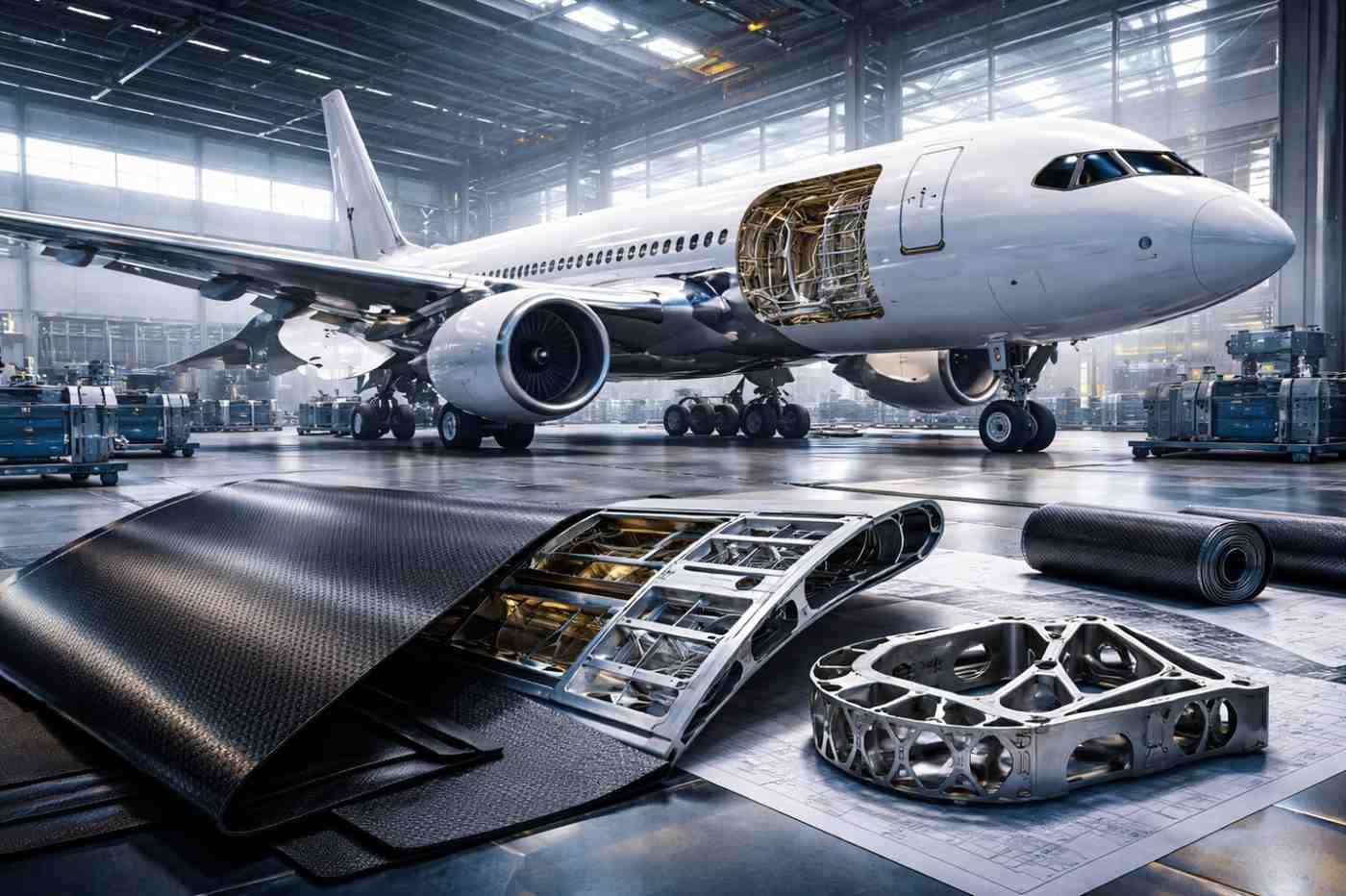
In the aerospace industry, weight is the eternal adversary. Every kilogram of structural mass added to an aircraft equates to increased fuel consumption, reduced range, or a lower payload capacity. For decades, engineers have operated under a strict mandate: make it lighter, but never sacrifice strength. The safety of passengers and crew relies on an airframe’s ability to withstand extreme aerodynamic forces, varying pressures, and harsh environmental conditions.
Fortunately, the era of heavy, all-metal aircraft is transitioning into a new age defined by material science innovation. By leveraging advanced composites, novel alloys, and cutting-edge manufacturing techniques, modern aviation is achieving what was once thought impossible: significant weight reduction coupled with superior durability. Here is how the industry is achieving the delicate balance between lightweight efficiency and high-strength performance.
1. The Carbon Fiber Revolution
The most significant shift in modern aviation design is the move from aluminum to Carbon Fiber Reinforced Polymers (CFRP). Unlike metals, which are isotropic (having the same properties in all directions), composites are anisotropic. This allows engineers to tailor the material’s strength specifically to the direction of the load it will carry.
CFRPs offer an exceptional strength-to-weight ratio, which is why they now constitute more than 50% of the structural weight of next-generation aircraft like the Boeing 787 and Airbus A350 XWB. By using carbon fiber for the fuselage and wings, manufacturers can create larger, more aerodynamic shapes that would be prohibitively heavy or mechanically impossible to forge with traditional aluminum sheets. Furthermore, carbon fiber is resistant to fatigue and corrosion, which extends the lifespan of the airframe and reduces maintenance requirements.
2. The Critical Role of Substrates
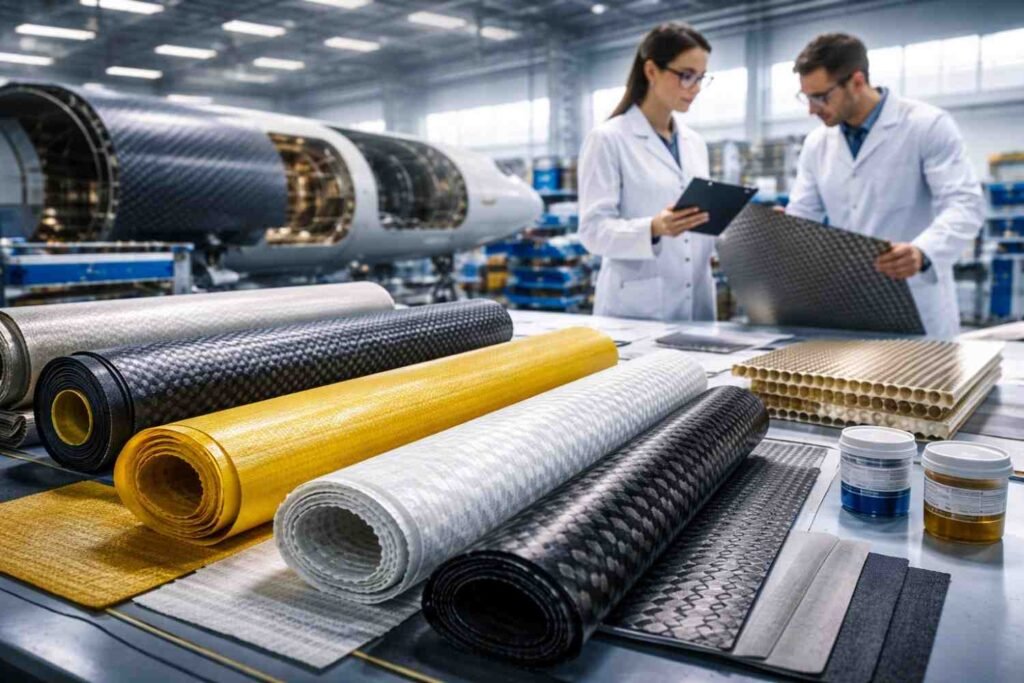
While the carbon fibers themselves take much of the glory, the integrity of a composite system relies heavily on the foundation upon which it is built. The reinforcement fabrics—typically fiberglass, quartz, or para-aramid—act as the backbone for various aircraft components, from radomes to interior panels.
To ensure these components can withstand the rigors of flight, manufacturers utilize aerospace grade substrates. These specialized fabrics provide the necessary dimensional stability and ensure uniform resin distribution during the curing process. Without high-quality substrates, the composite layers could suffer from inconsistencies, leading to potential structural weaknesses. By selecting the right substrate for specific thermal and mechanical environments, engineers can optimize the component for both weight and durability.
3. Honeycomb Sandwich Structures
To achieve stiffness without adding mass, aerospace engineers often utilize honeycomb sandwich structures. This design principle mimics nature, placing a lightweight core (often made of Nomex, aluminum, or Kevlar) between two thin, strong face sheets.
The geometry of the honeycomb core provides immense resistance to shear forces and compression while remaining mostly empty space (air). This results in a panel that is incredibly rigid yet weighs a fraction of a solid plate of the same thickness. These structures are ubiquitous in aircraft floor panels, control surfaces (like flaps and ailerons), and engine nacelles. The result is a dramatic reduction in weight that does not compromise the component’s ability to handle bending loads.
4. Advanced Aluminum-Lithium and Titanium Alloys
Despite the rise of composites, metal still plays a vital role in aircraft design, but the alloys have evolved. Standard aluminum is being replaced by Aluminum-Lithium (Al-Li) alloys. Lithium is the lightest metal element, and adding just a small percentage of it to aluminum reduces the alloy’s density while increasing its stiffness and strength.
Additionally, Titanium is increasingly used in high-stress areas, such as landing gear and engine pylons. While Titanium is heavier than aluminum, it is significantly stronger and, crucially, galvanically compatible with carbon fiber. When aluminum touches carbon fiber in the presence of moisture, it corrodes rapidly; titanium does not. This compatibility makes it the metal of choice for fasteners and structural reinforcements in composite-heavy airframes.
5. Additive Manufacturing and Topological Optimization
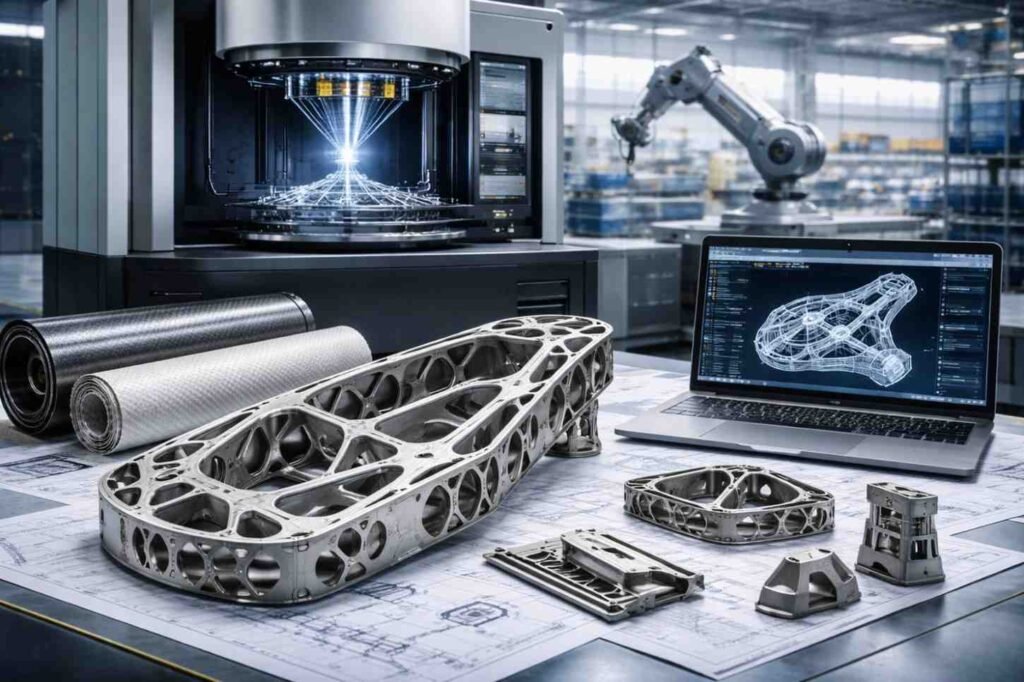
The method of manufacturing is just as important as the material itself. Additive manufacturing, commonly known as 3D printing, is revolutionizing how lightweight parts are conceived. Traditional subtractive manufacturing (milling a block of metal) restricts designs to simple geometries. 3D printing allows for topological optimization—a computer-driven design process that removes material from areas that do not bear loads.
This results in “bionic” shapes that look organic and skeletal but are mathematically optimized to be as light as possible while retaining full structural integrity. These parts, often printed from titanium or high-performance polymers, are now finding their way into non-critical and critical systems alike, shaving off weight gram by gram across the entire aircraft.
6. Integrative Structural Bonding
How an aircraft is put together affects its weight and strength. Historically, thousands of rivets were used to join fuselage panels. However, rivets add weight and create “stress risers”—points of weakness where cracks can initiate.
Modern designs increasingly rely on structural adhesives and bonding. By chemically bonding composite parts, the load is distributed evenly across the entire joint rather than being concentrated at rivet holes. This not only improves the fatigue life of the structure but also creates a smoother aerodynamic surface, further enhancing fuel efficiency.
Conclusion
The pursuit of the perfect aircraft is a continuous journey of balancing physics against materials. By integrating advanced composites, reliable substrates, and novel manufacturing methods, the aerospace industry is successfully reducing aircraft weight without compromising the safety and strength required for flight. As these technologies mature, we can expect future aircraft to be even more efficient, sustainable, and capable.