
It is no longer sufficient to have a visually appealing site. Best performing websites are designed to achieve one thing: conversion. That can be creating leads, pushing a purchase, or inspiring a sign-up; contemporary web design combines psychology, UX, and informed choices to influence the consumer’s actions.
To web designers, it is always stressed that conversion-oriented websites are not accidental. They are designed deliberately, both in terms of layout and message, as well as micro-interactions and speed. The following is the analysis of what experts are given priority when creating websites that do not merely generate traffic, but convert it.
Strategic Intent: The Foundation of Design Conversion

Clarity of intent is the basis of a high-converting site. Each page is to respond to one main question: What is it that the user should do next?
In the case of businesses investing in services such as Website laten maken Heist-op-den-Berg, analysts suggest that design choices should be made according to the intent of users and not on the internal preference. This comprises the knowledge:
- The reason why users are visiting.
- What problem are they solving?
- What is the most they are likely to do?
On the one hand, when intent is clearly outlined, design items, such as headlines to CTAs, become more purposeful and conversion-oriented.
Optimizing the Hero Section: Value Proposition Above the Fold
Professionals concur: the initial 5-8 seconds will decide whether a visitor will remain or not. The portion above the fold has to convey: What you have to sell, who it is addressing, and the importance of why.
Components of a High-Converting Hero Section
- A headline that makes benefits, and not merely describes.
- A subheading that explains the offer.
- One of the key CTA that can be distinguished.
- There are a few distractions or competing factors.
It is at this point that conversion rate optimization starts. Users will not scroll anymore unless they realize your value at first glance.
User Interface Design Rules that Govern Usability

Aesthetics are important – but usability transforms. According to the experts, the principles of good UX design can minimize friction and make navigation less complex. The users are not supposed to need to figure out how to use your site.
Basic UX Principles That Increase Conversions
- Easy to follow logical navigation structure.
- Regular designs on the pages.
- Quick loading pages (less than 3 seconds, preferably).
- Mobile-first responsiveness.
All these are what make the user experience pleasant, and are likely to make the user perform intended acts.
The Role of Tactical Visual Hierarchy in User Guidance
Attention is guided by visual hierarchy. In its absence, the user becomes confused. Hierarchy can be used by design professionals to emphasize important messages, draw the eye to CTAs, and divide important content from secondary information.
Design Elements for Effective Hierarchy
- Typography: Difference in font sizes.
- Color Theory: Strategic color contrast.
- Layout: Purposeful space and positioning.
A properly implemented visual hierarchy can make users follow the direction that you have created.
Establishing Credibility to Lower Decision Friction

Conversion does not simply mean persuasion, but lessening skepticism. When consumers are not sure of a brand, they are reluctant. This is why professionals incorporate trust signs from income to equity throughout the site.
Intense Impact Trust Elements
- Case studies and testimonials of clients.
- Approved ratings and reviews.
- Security badges (e-commerce, in particular).
- Contact numbers and company address.
These things legitimize your authority and are likely to make users more at ease with the action.
CTA Placement and Design: More Than Just Buttons
Calls-to-action (CTAs) are not thought about seriously. The professionals use them as conversion triggers, rather than as design elements. Successful CTAs are action-based (Get Started, Book a Demo), graphically different from other content, and placed strategically all over the page.
Best CTA Optimization Practices
- Locate the main CTA at the top of the fold.
- Repeat CTAs at the most important content sections.
- Employ contrast colors to attract attention.
- Do not give users an excessive number of choices.
Crafting Content That Resonates with User Pain Points
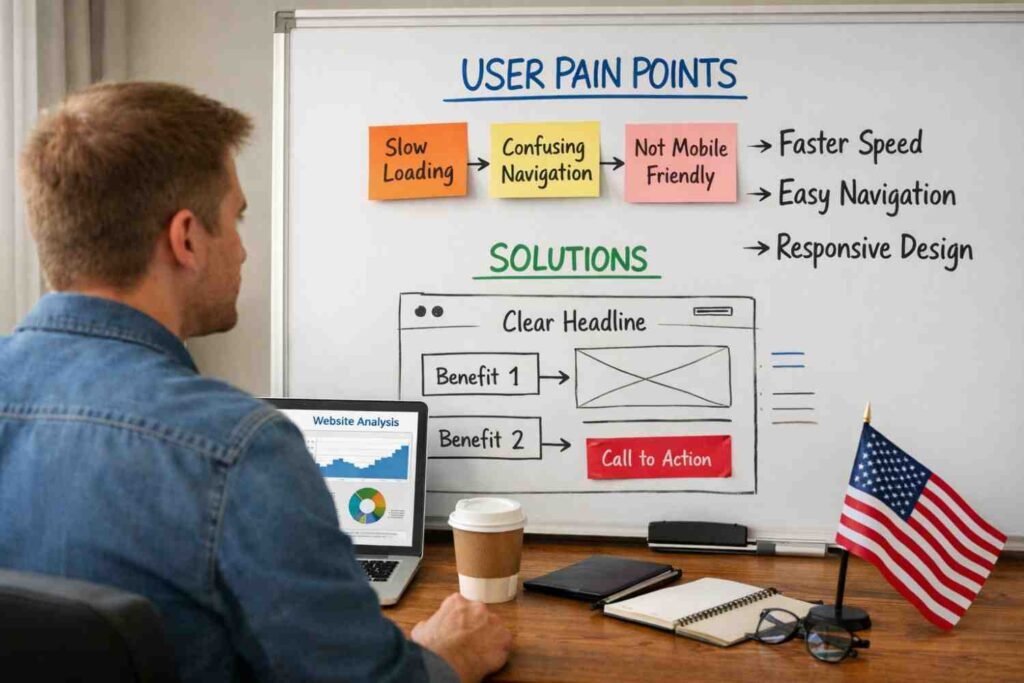
It is not a matter of design that changes it, but of messaging. Experts emphasize that it is essential to compose the content that explicitly targets user challenges, desired outcomes, and grievances.
High-Converting Messaging Styles
- Specific benefits over generalized statements.
- Real-world scenarios.
- Outcome-focused language.
This generates relevance, and relevance is critical in getting engaged and converting.
Technical Performance: Speed as a Conversion Driver
Speed is not only a technical measure, but also a conversion driver. It is always demonstrated in studies that even a one-second delay can lead to a major decline in conversions.
Expert Priorities for Site Performance
- Image and media optimization.
- Effective coding procedures.
- Top-quality hosting infrastructure.
The fast websites minimize the bounce rates and enhance the overall satisfaction rates of the users.
Evidence-Based Refinement: Endless Testing and Data

There is no perfect site at its launch. Experts use continuous optimization to enhance performance in the long run.
Important Optimization Practices
- A/B Testing: Comparing headlines, layouts, and CTAs.
- Heatmapping: Analyzing user behavior visually.
- Funnel Tracking: Identifying where users drop off.
- Data Adaptation: Adapting according to actual information and not guesses.
Harmony Between Design, Content, and Functionality
In conclusion, it is possible to say that the design of websites should be designed not to be pretty but to be effective. Convergent web design is not about style and trendiness per se, but rather about purposeful choices supported by strategy.
With such facets as clear messaging and user-friendly UX, quick performance, and trust-building factors, each of them is involved in directing users to do something. In the case of businesses that are looking at professional solutions, such as Website laten maken Heist-op-den-Berg, it is always prudent to develop a site that will benefit the user and the business’s cause. When the design, the content, and the functionality are all in harmony, the outcome is a site that not only captures the traffic but also turns it into results that can be measured regularly.