

Two sellers, same deal, and one quote comes back at four times the other. I’ve watched that happen. The frustrating part is that the cheaper quote wasn’t a scam and the expensive one wasn’t greedy. They priced two different things. A data room isn’t a product with a sticker on it. It’s a configured environment, and what you configure is what you pay for.
So if you’re trying to figure out what a deal is actually going to cost you, here’s the short version: project type, duration, storage, number of projects, number of admins, and support level set the price. Everything else is a footnote. Below, I’ll walk through each factor, show you where sellers pad quotes, and give you a way to compare options that doesn’t require a finance degree.
Why there’s no standard price tag

You won’t find a data room on a shelf with a barcode. Sellers price around usage, which is why a single-project room for a small acquisition looks nothing like an enterprise setup running several deals at once. Same software, wildly different invoices.
Sellers also charge on different axes. Some bill per page, some per gigabyte, some per user seat, and some roll everything into a flat fee per project. That’s why comparing two quotes line by line is useless until you convert both into the same unit. Ask each vendor what their pricing unit actually is. Usually one structure will fit your deal better, and it’s often obvious once you see it written down.
The six factors that actually move the number
Strip away the sales deck and every quote traces back to these. I’d rank them in roughly this order of impact, though your deal might shuffle the list.
Project type: the factor buyers underestimate
A simple document exchange and an M&A room are not the same animal, even if both are called a data room. Sell-side M&A needs granular permissions, a Q&A module, watermarking, and reporting that shows who opened which file and when. A real estate deal may need fewer moving parts but heavier document volume. A due diligence process sits somewhere between, leaning on access control and version tracking.
More capability means more configuration, and configuration is labor. If a vendor walks you through a feature list and you find yourself saying “we don’t need that” more than twice, you’re probably looking at the wrong tier. According to the Small Business Administration, most small firms operate with tight budgets and lean teams, which makes overbuying on a data room more painful than it looks on a spec sheet. Pay for the controls your deal requires and not one feature more.
Duration: why a two-week deal shouldn’t cost the same as a two-year one
Short transactions cost less. Long ones cost more. Some vendors bill monthly, some bill per quarter, and some charge a flat project fee that quietly assumes a standard window. If your deal runs long, that flat fee can turn into an overage. Ask what happens on day 91 of a 90-day contract. I’ve seen that single question change a quote by a meaningful margin, because sellers know the answer matters and not all of them volunteer it.
Storage, projects, and people
Storage is the most measurable cost driver, so it’s also the one sellers love to cap. A tier might include a set number of gigabytes, then charge per gigabyte beyond that. Dense documents, scanned files, and video walkthroughs eat space fast. Clean up before you upload and you’ll sometimes drop into a lower tier.
The number of projects is a blunt instrument in pricing. One room fits a mid-tier plan. Several rooms running at once push you into an enterprise package whether you wanted one or not. If you’re running back-to-back deals, ask whether the vendor charges per active project or per concurrent project. That distinction matters more than most buyers realize.
Then there’s the user-versus-admin trap. Users open documents. Admins configure the room and manage permissions, and several vendors count admins as billable seats. Map out who actually needs admin rights before you sign anything. Half the time, one person can hold the admin role and everyone else can work as a standard user, which trims the bill without touching security.
Security and support: the line item that justifies itself
Advanced permissions, audit trails, and reporting cost more than a bare file share, and that’s the point.
Advanced permissions, audit trails, and reporting cost more than a bare file share, and that’s the point. State-of-the-art technology can provide the specialized capabilities needed to manage sensitive information, control access, and maintain visibility throughout a transaction.
If your deal involves confidential financials or a competitive bidding process, those controls aren’t upsells. They’re the reason you’re using a data room instead of a Dropbox folder.
Security isn’t optional scaffolding, either. According to the National Institute of Standards and Technology, protecting the confidentiality of information is a baseline expectation for any organization handling sensitive data, not a premium add-on.
And if you’re dealing with personal information, the Federal Trade Commission enforces rules on how that data gets handled, which is worth remembering when a vendor’s cheapest tier strips out access controls to hit a price point.
Support is the other stealth cost. A vendor with a live person on call is worth more at 11 p.m. the night before a bid deadline than a chat bot that loops you back to a FAQ page. If your timeline is tight, pay for responsive support. If you have weeks of slack, you don’t need it.
A framework for comparing quotes without getting fooled
I call this the Three-Question Test. Run every quote through it before you talk yourself into a fancy demo.
- What’s the billing unit? Per project, per gigabyte, per user, or flat fee. Once you know this, you can convert every quote to the same scale.
- What happens when you go over? Extra users, extra storage, extra weeks. Overage rates are where cheap quotes quietly become expensive ones.
- What’s stripped out of the base price? Audit trails and Q&A are the usual casualties. If your deal needs them, add them back before you compare numbers.
Write the answers side by side. Most of the time, one vendor’s quote stops being a bargain and starts being a different product entirely. The same principle applies when choosing the right technology for your business: the lowest price only matters if the solution actually fits your requirements.
Most of the time, one vendor’s quote stops being a bargain and starts being a different product entirely. That’s not deception. It’s just what a configured room costs when you configure more of it.
When to pay more, and when to push back
Pay up for security, Q&A, and support if your deal involves multiple bidders or a compressed timeline. Push back on anything you can’t see yourself touching. If nobody on your team will run reports, a reporting module is dead weight. If you’re running a small acquisition with three parties, an enterprise tier is theater.
It helps to get a sense of what each configuration runs before you commit, so you can walk into the negotiation with a target instead of a shrug. The 2026 overview of virtual data room cost lays out pricing logic across project types, M&A, due diligence, and real estate, which is useful when you want to sanity-check a quote before you respond to it. Compare that reference against the quote in front of you and you’ll spot the padded line items faster.
The bottom line on data room pricing
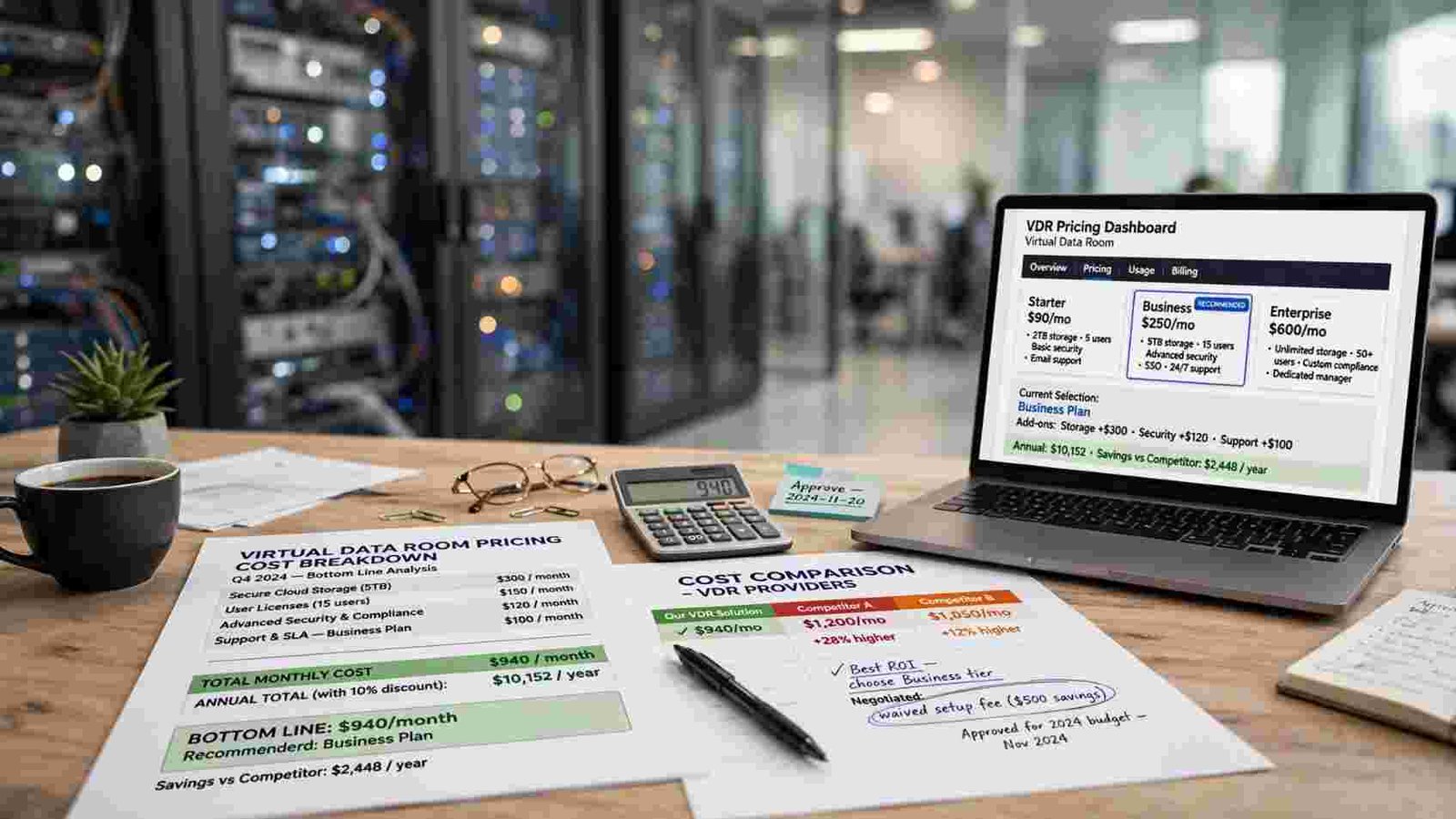
Your invoice is a description of your deal. Longer timelines, more projects, heftier files, more admins, and richer security controls all push the number up, and every one of those choices is yours to make.
So before your next negotiation, ask what the vendor is actually counting. Then ask yourself whether you need what they’re selling. What’s the one line item on your last quote you couldn’t justify if someone asked?