
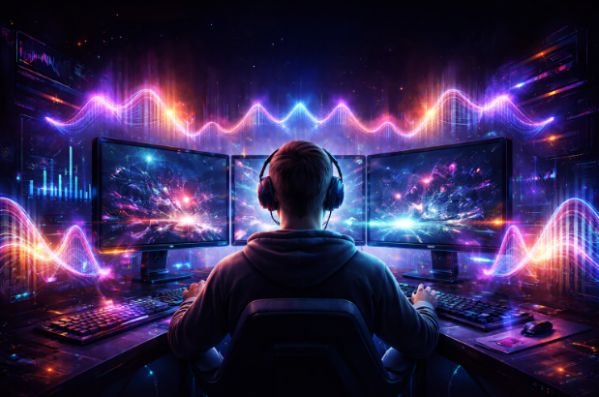
If you are searching for Gaming Harmonicode Technology, you are likely trying to understand what it actually means and whether it represents a real shift in the gaming industry or just another trend.
Gaming Harmonicode Technology refers to the integration of harmonic sound structures, algorithmic systems, and real-time player interaction to create immersive digital environments where audio is not just background noise but part of the gameplay engine itself.
In this complete guide, you will learn what this Technology is, how it works, its practical applications, industry impact, technical challenges, and why it may define the next generation of immersive gaming.
Key Takeaways
- Gaming Harmonicode Technology merges sound frequencies with game logic
- It allows audio to function as both input and output
- It enhances immersion and accessibility
- It introduces new competitive and creative formats
- It has growing relevance in esports and Artificial Intelligence development
What Is Gaming Harmonicode Technology?
It is a system where harmonic frequencies and layered audio signals are embedded into core game mechanics. Instead of music being decorative, it becomes functional.
In traditional games, sound provides atmosphere. In harmonicode systems, sound acts as a structural component. A chord progression may unlock a level. A shift in frequency may change physics parameters. A rhythm pattern may alter artificial intelligence behavior.
This approach transforms sound into executable logic.
The Core Mechanics Behind Gaming Harmonicode Technology
Understanding the architecture of this Technology requires breaking it into functional layers.
Harmonic Encoding Systems
Harmonic encoding uses layered frequencies to represent in-game actions. Different pitches or combinations can signal commands.
For example:
– A minor chord might trigger stealth mode
– A high-frequency burst might activate a defensive shield
– A rhythmic sequence might initiate a level transition
Real Time Audio Processing

Low latency digital signal processing allows the system to interpret sound in milliseconds. This ensures the player experiences immediate feedback.
AI Driven Music Engines
AI models generate evolving soundtracks that adapt to player behavior. These systems do not simply react; they predict patterns.
Why Gaming Harmonicode Technology Matters
It is not only about innovation. It addresses deeper industry needs.
Immersion
When gameplay responds to music, the player experiences emotional synchronization. The world feels alive.
Accessibility
Audio driven mechanics create inclusive design possibilities for visually impaired players who rely on sonic cues.
Competitive Strategy
Esports platforms are experimenting with sound based strategy layers. Timing, pitch recognition, and harmonic alignment can influence outcomes.
Real World Applications of Gaming Harmonicode Technology

Although still emerging, practical implementations already exist.
Experimental Game Prototypes
Independent studios are building titles where environmental shifts occur through frequency alignment.
Rhythm Based Strategy Games
Instead of simple beat matching, these games use tonal harmony as tactical input.
Esports Integration
Competitive environments can use harmonic data to influence power ups or AI controlled elements.
Therapeutic and Educational Gaming
It is being explored in cognitive therapy systems where harmonic balance impacts progress levels.
Technical Challenges in Implementation

Despite its potential, it faces obstacles.
Hardware Variability
Audio hardware differs across platforms. Consistency in detection is complex.
Learning Curve
Players without musical familiarity may find harmonic systems intimidating.
Processing Demands
Real time audio modulation requires optimized computational pipelines.Developers must balance immersion with usability.
The Future of Gaming Harmonicode Technology
The future development of thisTechnology may align with advancements in artificial intelligence, virtual reality, and neural input systems.
AI Adaptive Worlds
Game environments may evolve entirely based on harmonic behavior patterns.
VR Integration
Virtual reality combined with spatial audio mapping can create fully responsive sound based landscapes.
Brain Computer Interfaces
Neural signal detection could integrate directly with harmonic encoding models, building on principles of signal detection in neural populations to interpret brain activity patterns in real time. This could redefine digital interaction beyond traditional controllers.
Industry Impact and Market Potential
The global gaming industry continues expanding rapidly. Audio innovation represents a new frontier. Major growth factors include:
- Increasing esports investment
- Rise of immersive gaming demand
- Advances in AI driven content generation
- Demand for differentiated gameplay experiences
It aligns with all these drivers.
Frequently Asked Questions:-
1. What is Gaming Harmonicode Technology?
It is a system where harmonic audio signals are integrated into gameplay mechanics, allowing sound to function as a command and structural element within digital environments.
2. Is Gaming Harmonicode Technology widely adopted?
Currently it remains experimental but growing, especially within indie studios and research driven development environments.
3. Does Gaming Harmonicode Technology require musical knowledge?
No formal musical training is required. User interfaces are designed to interpret intuitive sound patterns rather than complex theory.
4. Can Gaming Harmonicode Technology be used in esports?
Yes, experimental esports environments are exploring harmonic based competitive mechanics.
5. Is Gaming Harmonicode Technology the future of gaming?
While not replacing traditional mechanics, it represents a powerful evolution in immersive and interactive design.
The Rise of Gaming Harmonicode Technology
Gaming Harmonicode Technology represents more than a design trend. It merges sound engineering, artificial intelligence, and immersive mechanics into a unified system.
As digital environments grow increasingly complex, the integration of harmonic structures into game logic may define the next era of interactive entertainment.
If current innovation trends continue, it will move from experimental niche to mainstream influence in competitive gaming, immersive storytelling, and AI driven simulation systems.