
Proper handling of medical waste management requires organized records, careful tracking, and consistent awareness of safety rules. Clear documentation supports accountability while reducing risks connected with disposal activities. Many organizations focus on structured paperwork to maintain regulatory alignment and improve operational clarity.
Reliable records help staff respond confidently during inspections and maintain smooth workflows. Attention to detail, timely reporting, and transparent communication together build a strong foundation for safe waste handling practices while supporting long term operational stability.
Documentation Basics
Clear written records form the backbone of medical waste disposal in virginia oversight. Accurate logs, collection reports, and disposal verification help maintain accountability. Well-organized documentation also supports smoother communication between staff members and regulatory reviewers.
Record Types
Maintaining structured documentation helps facilities stay organized and ready for inspection review. Various records support transparency and operational accountability.
- Waste tracking logs show quantity details, disposal timing, and responsible personnel identification
- Incident reports describe unusual situations, corrective actions taken, and follow-up evaluation steps
- Training attendance sheets confirm staff awareness regarding safe handling procedures and compliance responsibilities
- Vendor service receipts verify proper removal activities and demonstrate adherence to accepted safety standards
Compliance Value
Consistent documentation demonstrates responsibility and builds confidence among oversight bodies. Records provide evidence that safety practices are followed correctly. Detailed paperwork also helps identify patterns requiring improvement.
Organized files simplify inspection preparation work because they decrease evaluation assessment uncertainty. Staff members achieve higher confidence in their roles through the existence of clear, documented procedures.
Storage Notes
Safe document storage supports accessibility while protecting sensitive information from damage or loss. A reliable organization ensures smoother review processes.
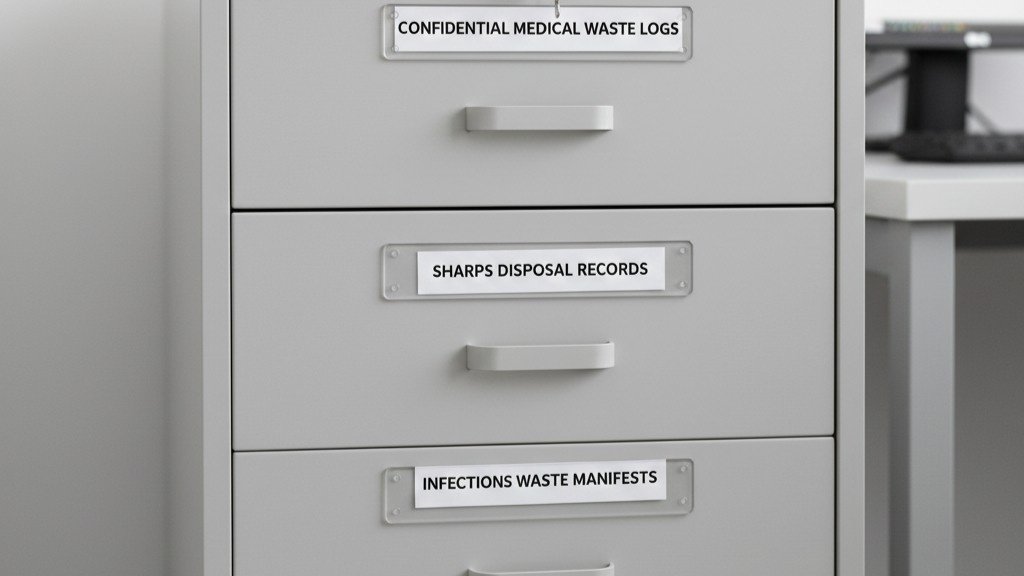
- Maintain secure cabinets to protect sensitive paperwork from unauthorized access or accidental damage
- Use clear labeling systems so staff can locate required records quickly without confusion
- Preserve electronic backups regularly to prevent loss caused by unexpected technical issues
- Review stored files periodically to confirm relevance and remove outdated material responsibly
Staff Training
Employees play a vital role in maintaining proper documentation standards. Employees need regular instruction to learn the reporting procedures, together with record accuracy requirements. The organization benefits from clear guidance because it helps employees work correctly and maintains operational consistency.
The information staff members receive about proper form completion procedures leads to more efficient audit processes. Ongoing education also encourages awareness of safe waste handling responsibilities and proper reporting methods.
Audit Checks
Routine internal checks prepare facilities for external inspections and strengthen documentation reliability. Periodic review improves consistency.
- Conduct scheduled internal reviews to confirm records reflect accurate operational activities and procedures
- Compare documentation with disposal schedules to ensure reporting accuracy and completeness standards
- Encourage team feedback regarding record clarity to improve documentation usability and efficiency
- Maintain corrective action notes demonstrating response to identified issues and ongoing improvement efforts
Risk Control
Effective documentation reduces potential compliance risks. Clear records provide evidence of responsible medical waste disposal in virginia. The early detection of irregularities depends on organized files, which enable organizations to implement necessary corrective actions at the right time.
The establishment of regular documentation practices enables organizations to build trust with regulators while achieving better operational results. The implementation of structured record management systems ensures safer work environments and enables improved staff security through enhanced accountability methods.
Safe Outcomes

Responsible documentation practices create stronger oversight, clearer communication, and improved operational confidence. Balanced record keeping helps facilities meet safety expectations while reducing uncertainty during inspections. A structured approach combining accurate records, regular review, and staff awareness supports reliable compliance and long-term operational integrity.
FAQs
1. Why is documentation important in medical waste management?
It provides evidence of proper handling, supports safety standards, and simplifies inspection readiness.
2. How often should records be reviewed?
Periodic internal reviews help maintain accuracy and prepare facilities for official evaluations.
3. Who manages documentation tasks?
Trained staff members usually maintain records under the supervision of compliance coordinators.
4. What happens if documentation is incomplete?
Missing records may lead to compliance concerns, operational delays, or additional inspection scrutiny.