

A great golf swing is not born overnight. It is forged through countless hours of repetition. However, pounding hundreds of balls at the driving range can become monotonous, and the progress can feel slow. The key to consistent improvement is not just practicing more, but practicing smarter.
Introducing creative drills and new environments into your routine can sharpen your focus, reveal weaknesses, and make the process more enjoyable.
This guide offers innovative ways to practice your golf game, moving beyond the standard range session. From your living room to the practice green, these techniques will help you build a more well-rounded and reliable game.
Master the Short Game from Anywhere
Most strokes are lost within 100 yards of the hole. Improving your putting and chipping is the fastest way to lower your scores. The good news is that you do not need a golf course to practice these crucial skills.
Living Room Putting Drills
Your carpet can become your personal practice green. A simple drill involves placing a coin on the floor and trying to land your ball directly on it. This forces you to focus on a tiny target, making the actual hole seem huge by comparison.
Another effective drill is the “gate” drill. Set up two objects, like books or water bottles, just wide enough for your putter head to pass through. Place your ball in the middle and practice making a stroke without touching the sides. This builds a consistent, straight-back, straight-through putting motion.
Backyard Chipping Challenges
Your yard offers a perfect space to practice short chips. Instead of aiming for a hole, set up different targets. You could use a bucket, a towel, or a hula hoop. Vary the distances and lie of the ball to simulate real course conditions. Try chipping from thicker grass to practice getting out of the rough.
Challenge yourself to land the ball in the target area a certain number of times in a row before you stop.
Reinventing Your Driving Range Sessions
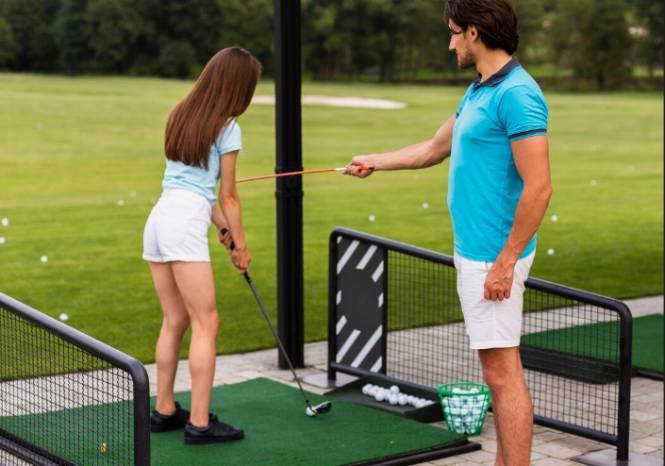
The driving range is essential, but mindless hitting yields little benefit. To get the most out of your time, you need to practice with intention.
Simulate a Real Round
Do not just hit your driver over and over. Instead, play a virtual round on the range. Visualize the first hole of your favorite course. Hit the club you would use off the tee. Then, select the club you would use for your approach shot. Continue this process for an entire 18 holes. This approach forces you to use every club in your bag and practice shot transitions, just like you would during a real game.
Focus on Shot Shaping
Devote part of your practice to intentionally curving the ball. Pick a target and try to hit a draw (right-to-left for right-handers) or a fade (left-to-right). This exercise improves your control over the clubface at impact. Even if you do not need to shape shots often on the course, learning how to do it gives you a much better feel for your swing mechanics.
Embrace Technology for Deeper Insights
Modern tools provide feedback that was once only available to professional services. Integrating technology into your practice can accelerate your improvement by giving you precise data on every swing. While high-end launch monitors at a commercial facility can be expensive, many accessible options exist.
Simple smartphone apps can record your swing for slow-motion analysis, helping you spot flaws in your form. Some tools even provide data on swing speed and tempo. For an all-weather, immersive experience, a virtual golf simulator allows you to play famous courses from around the world without leaving your home.
It provides detailed analytics on every shot, helping you understand ball speed, launch angle, and spin rate. This instant feedback loop is invaluable for making targeted adjustments.
Build a Better Swing with Drills

Targeted drills isolate specific parts of the swing, allowing you to build muscle memory and correct bad habits.
The Split-Hands Drill
To improve your club control and release, grip the club with your hands several inches apart. Take slow, half-swings. This drill exaggerates the feeling of the clubhead rotating through impact. It helps you develop a better sense of timing and ensures your hands and body are working together.
The One-Foot Drill
To improve your balance, practice hitting short iron shots while standing on one foot. Start by standing on your lead foot and then switch to your trail foot. This will quickly expose any swaying or instability in your swing. A stable base is the foundation of a powerful and consistent golf shot.
Conclusion
Improving your golf game requires dedication, but it does not have to be a chore. By incorporating creative drills, practicing with intention, and leveraging technology, you can make your practice sessions more effective and engaging. Forget the mindless repetition.
Start practicing with purpose, whether in your backyard or on the range. Try these methods, and watch your skills and confidence grow in the course.