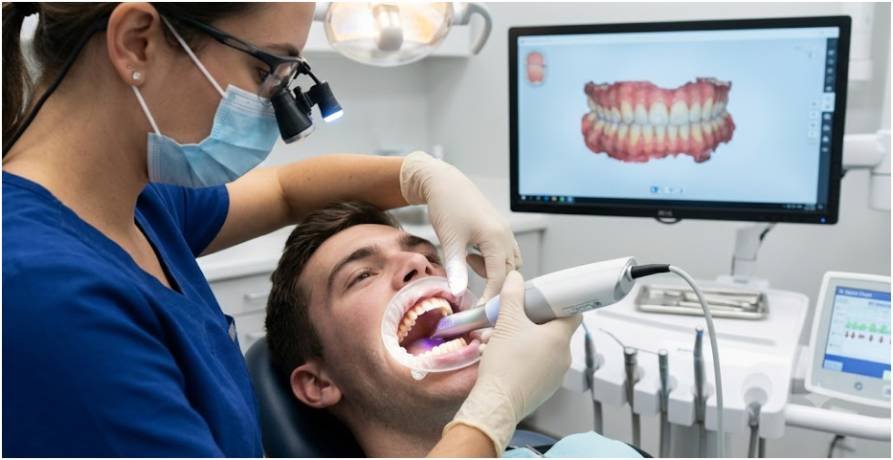
Your grandparents’ orthodontic records are sitting in a box of plaster somewhere. Yours are a file.
That switch happened fast, and most people only notice the part that lands on them directly: nobody packs a tray of cold putty into your mouth anymore. If you had impressions taken before roughly 2015, you know the routine. The tray that never quite fit. Four or five minutes of breathing through your nose and trying to think about anything else. Then the retake, because the tech pulled the tray and found a bubble sitting right where your molar should be.
3D intraoral scanning took over that job, and comfort is the smallest part of why.
This is what you can expect in the next ten minutes: how the wand creates the model of your mouth, what exactly the research says about the accuracy, where there are still problems for scanners, and what happens with the scan file once you leave the place. If you are considering the idea of clear aligners for now, you should know that this very scan is the first step for any Invisalign Las Vegas case.
A yellow box in Zurich started all of this
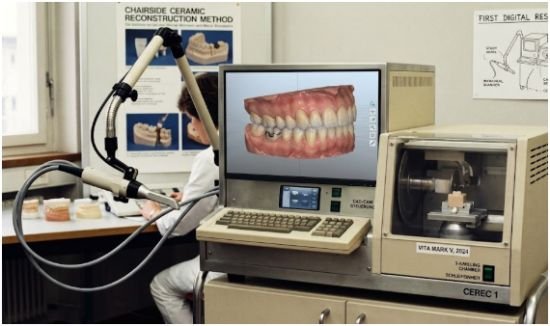
The first chairside digital dentistry system was a prototype so ugly its inventors nicknamed it “the lemon.” Werner Mörmann and Marco Brandestini ran the first CEREC chairside treatment on September 19, 1985, at the University of Zurich Dental School, and you can read Mörmann’s own account of it in the Journal of the American Dental Association. One camera. One tooth. A milling unit the size of a washing machine.
For about twenty years, that was the whole category. Then orthodontics got involved, and the target changed from a single prepped tooth to your entire arch, both of them, plus your bite.
That is a much harder problem than it sounds.
What the wand is actually doing in there
The wand is a camera. It does not measure your tooth the way a caliper would. It takes an enormous number of images at slightly different positions, then software stitches those overlapping frames into one continuous surface map, the same basic idea as a panorama on your phone but running in three dimensions and at a scale measured in microns.
Older scanners used confocal imaging with a single camera in the base of the wand, capturing roughly one to two teeth per pass. Newer hardware went a different route. When Align launched the iTero Lumina in January 2024, the company replaced confocal imaging with a multi-angle capture approach, in a wand 50% smaller and 45% lighter, with a capture distance of up to 25mm, according to Align’s launch announcement. Wider view, fewer passes, less time with your jaw open.
The output is a mesh file. Millions of tiny triangles describing every surface the camera saw. That file is what gets sent out, not a box.
Why the scanner needs you to hold still
Stitching is where scans go wrong. If your tongue drifts into frame, or you swallow mid-pass, the software may try to align two frames that do not belong together, and the error compounds across the arch. Saliva pooling in the lower arch does the same thing. Your assistant retracting your cheek and telling you to breathe normally is not fussiness; it is the accuracy protocol.
Long spans without landmarks are the hardest part of your mouth to capture, which is why a smooth palate or a gap where a tooth used to be takes longer than a crowded lower front.
Does the scan beat the putty? Here is what the studies found
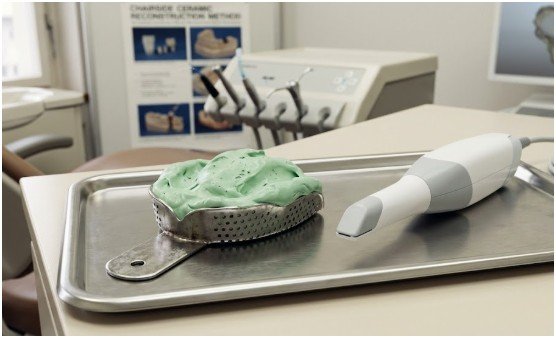
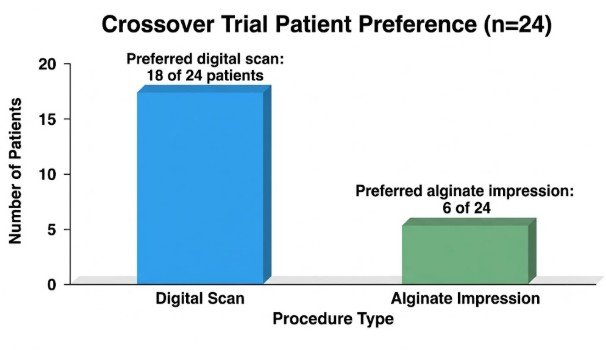
On comfort, the evidence is one-sided. In a crossover randomized trial where 24 orthodontic patients aged 6 to 11 received both an intraoral scan and an alginate impression a week apart, 18 of them preferred the digital scan, scanning ran about 118 seconds faster, comfort scores came out higher, and gag reflex and breathing difficulty both scored lower. That trial is indexed on PubMed if you want the confidence intervals.
Two minutes does not sound like much until you are eleven years old with a tray in your mouth.
On accuracy, the honest answer is more mixed than any brochure suggests. A 2025 umbrella review pooled 10 systematic reviews covering more than 30 scanner models and found that scanners generally cut procedure time and improved patient comfort, with TRIOS 3 and Primescan ranking highest for complete-arch accuracy.
The same review flagged that accuracy in partially edentulous and fully edentulous arches remained a limiting factor. You can read the full umbrella review on PubMed Central.
What happens |
Putty tray |
Digital scan |
Chair time |
Set time you cannot rush |
Faster in most comparisons |
Retakes |
Requires a whole new tray |
Rescan the bad section only |
Storage |
Physical model, degrades, gets lost |
File, copied and backed up |
Shipping |
Boxed and mailed |
Uploaded |
Seeing your own teeth |
You do not |
On screen before you stand up |
Where scanners still lose
Deep subgingival margins, profuse bleeding, and highly reflective restorations can pose problems for the scanner. Even some dentists resort to physical impressions in certain implant cases, and there is literature backing them instead of criticizing them. Any office telling you the tray is dead in every situation is overselling.
The file is the real product
Once your scan is captured, it stops being about your appointment and starts being about manufacturing.
That mesh becomes the base for a treatment plan. Software segments each tooth as an individual object, then a technician and your doctor stage the movement, tooth by tooth, step by step. The staged positions get printed as models, and aligners are formed over them. Your file is also the reference every later scan gets measured against, which is how progress tracking works without anyone guessing. Cloud-based solutions are changing medical office operations while keeping the records including scans and cases.
This is where provider volume starts to matter to you as a patient. The clinical judgment in the setup, how much movement per stage, where attachments go, when to build in overcorrection, is where a practice earns its results, and offices running a high case volume have seen far more of what goes wrong.
A team handling Invisalign Las Vegas cases weekly reviews more staging plans in a month than a low-volume office sees in a year, and that repetition shows up in how confidently they modify a default plan.
Align kept building on that chairside file too. In October 2025, the company announced additions to its iTero software, including simplified oral health reports shareable by QR code and an outcome simulator that produces in-face video of a projected smile, per the Align announcement. Whether a simulation should drive your decision is a separate conversation, and my own take is that it sells better than it predicts.
Five things worth asking at your scan appointment
- Can I see the scan on screen before I leave?
- Which scanner is this, and how old is it?
- Do I get a copy of my file if I move or switch offices?
- How long are my records kept?
- What happens if the lab flags my scan as unusable?
That third one catches people out. Your scan is your record, and portability is worth confirming before you need it.
The part nobody sees
The wand is the only piece of this you experience. Everything that determines your result happens after, in software, in staging decisions, in whoever reviews the plan before it goes to manufacturing.
So when you are comparing offices, the scanner model is the least interesting thing on the list. Ask what happens to the file.