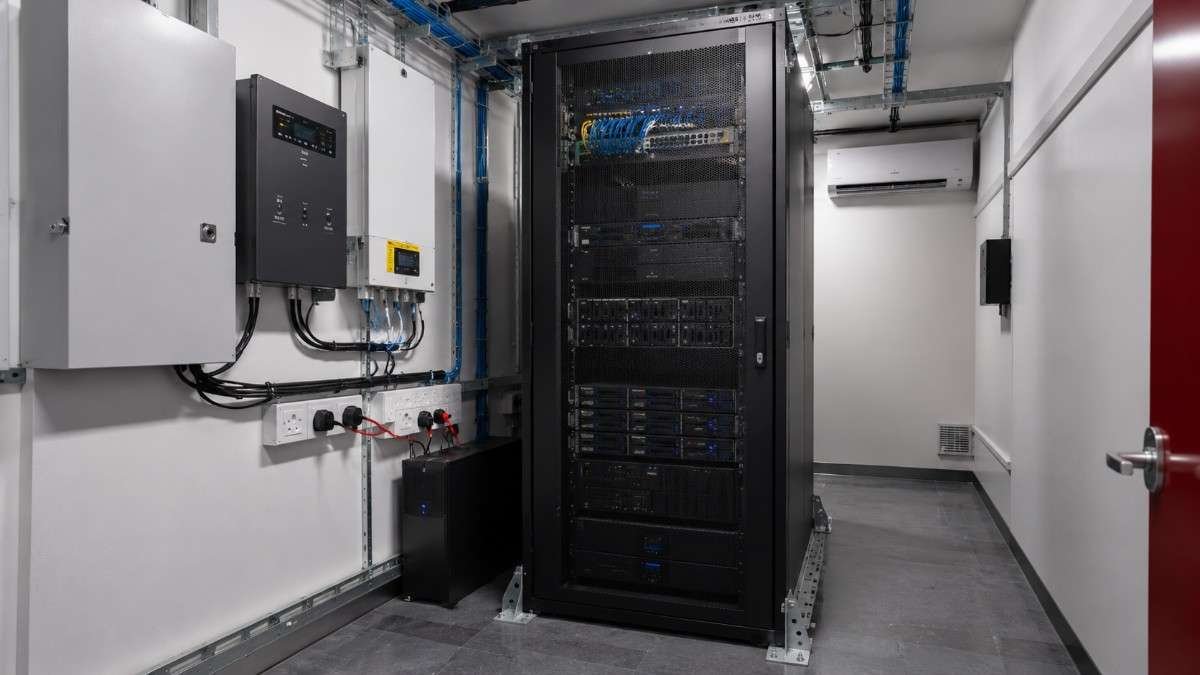
The infrastructure for surveillance systems has evolved considerably within the last ten years. Things that were once only possible in a dedicated room and by installing extensive cabling have shrunk to be able to be placed in a wall-mounted device. Yet despite this progress, many installations still fail — not because of bad hardware, but because of mismatched expectations about operating environments.
Climate variations, electrical power availability, Internet availability, and compliance structures within the locality will ultimately decide if the security system works in practice. In this respect, it is especially applicable to areas which have rough terrain and widely dispersed populations. It is here that the discussion of the use of NVR recorders for Australia & New Zealand gets truly interesting.
The idea of “installation and forgetting about it” is quite attractive, but it hardly holds up when meeting with reality. The issues include corrosive coastal environment, hot inland environment, power fluctuations in rural areas, and earthquake-prone locations. Understanding these conditions before selecting hardware is not optional — it is the entire job.
The Geography Problem No One Talks About
The problem faced by both Australia and New Zealand is peculiar in terms of surveillance. Large geography and low population density characterize this problem in both the countries. An example can be that of a sheep station in Queensland, a wine farm in Marlborough, and a building site in Northern Territory. This means systems must be configured for minimal on-site intervention. Remote firmware updates, self-healing RAID storage, and automatic alert logging are not premium features in these contexts — they are baseline requirements.
The urban installation in Sydney, Melbourne, Auckland, and Wellington has a totally new problem – density. Multi-tenant buildings, parking lots, shopping malls, and precincts all need channel scalability and integration with access control. And the exact same type of equipment has to go from a remote four-camera home configuration to a 64-channel commercial application.
Heat, Humidity, and the Outdoors-First Mindset
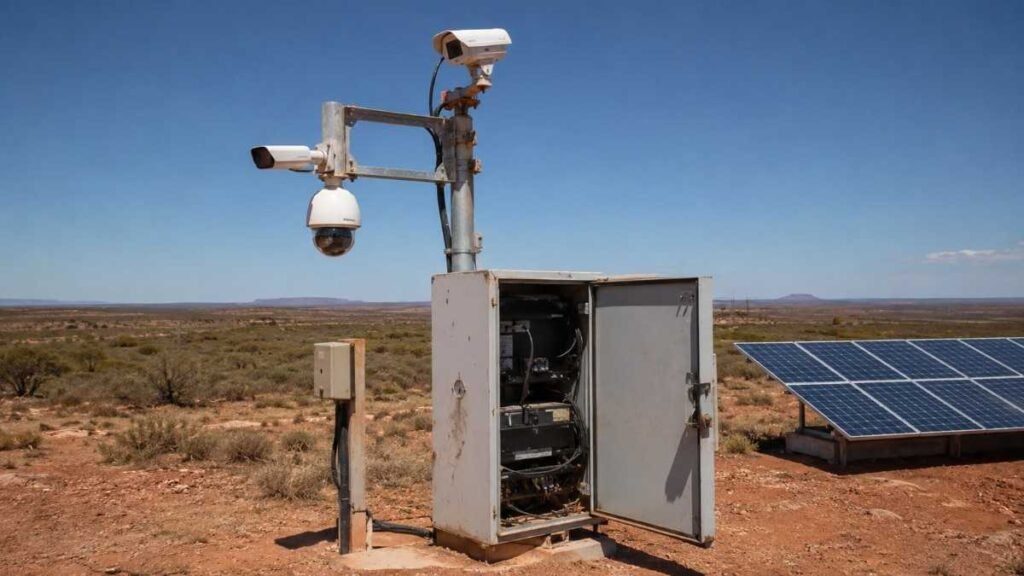
Australian summers routinely push ambient temperatures past 40°C in inland regions. Northern Queensland and the NT sustain high humidity for months at a stretch. New Zealand’s West Coast experiences some of the highest annual rainfall on the planet. These are not edge cases — they are the norm for large portions of the installed base.
Storage drives inside recording units are particularly vulnerable to temperature-induced failure. Units designed for indoor server environments typically operate within a 10–35°C range. When positioned in a poorly ventilated equipment cabinet on a rural property, ambient temperatures can exceed this range for hours at a time. Look specifically for units rated to operate at 55°C or above, with active cooling or intelligent fan management, rather than relying on passive ventilation assumptions.
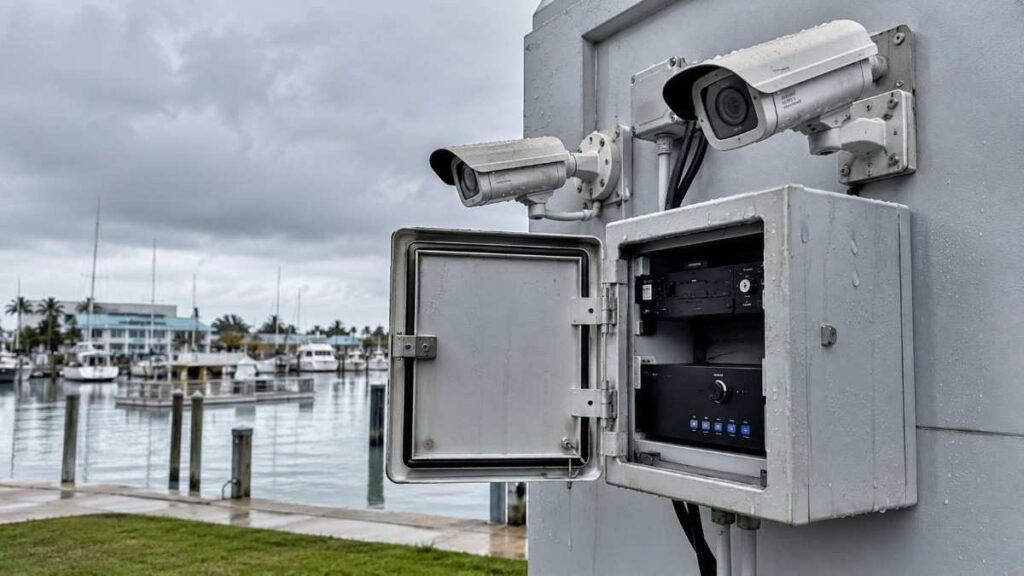
Humidity protection matters equally. Condensation inside electronics is a slow killer. Units deployed in coastal installations — marinas, fishing operations, outdoor hospitality venues — benefit from conformal coating on internal circuit boards and sealed HDD bays. These are specifications worth requesting from a distributor, not assuming.
Power Instability: The Silent System Killer
Rural and semi-rural areas across both countries experience power fluctuations that urban installers rarely plan for. Voltage spikes during storm season, brownouts in summer when agricultural demand peaks, and momentary outages during grid switching events all create write corruption risks on surveillance storage. An uninterruptible power supply is standard advice, but the recording unit itself needs graceful shutdown capability — the ability to finalise open video segments and flush buffers before power loss becomes catastrophic data loss.
For solar-powered installations, common on remote stations and eco-tourism sites, the DC input range of the recorder matters enormously. Systems that accept 10–30V DC input eliminate the need for additional DC-to-AC conversion, reducing failure points and energy waste. This is a niche but genuine regional consideration that shapes purchasing decisions in ways that international product listings rarely address.
Connectivity Realities and Hybrid Recording Strategies
Reliable broadband is not universal across either country. Despite the increased availability of fibre in metropolitan areas, satellite and 4G LTE still form the core of the available connection choices for many business and personal premises. This has ramifications for the backup plan, ability to view remotely, and alerts sent.
In such scenarios, the best possible approach will be edge-first recording; recording in full resolution at the local level, then sending low bandwidth recordings or still images to the cloud or monitoring center.
When evaluating NVR recorders for Australia & New Zealand deployments, prioritise those with intelligent motion event filtering at the device level. Sending full streams over a constrained LTE connection is both expensive and often unreliable. Sending a 10-second clip when a perimeter camera detects motion is efficient and functional.
Dual-stream recording — main stream for local high-resolution storage, sub-stream for remote monitoring — has become standard in quality units. Confirming that this capability exists and is configurable through a straightforward interface saves significant headaches during commissioning.
New Zealand’s Seismic Factor
Global product documentation rarely mentions seismic resilience, but New Zealand commercial installations need it. Installers should anchor equipment racks and recording units according to local building codes in earthquake-prone zones. Beyond the physical setup, businesses should configure the recording system with geographically separate backup destinations, such as a cloud region outside the South Island or a secondary local NVR in another building.
After the Canterbury earthquakes, several businesses discovered that their surveillance footage — which might have assisted with insurance claims or post-incident investigation — was physically destroyed along with the premises. Off-site redundancy is a genuine business continuity argument, not a theoretical one.
Compliance, Privacy, and the Regulatory Landscape
Both countries operate under privacy legislation that governs how surveillance footage can be captured, stored, and accessed. Australia’s Privacy Act and New Zealand’s Privacy Act 2020 each place obligations on organisations that collect personal information through monitoring — and video footage of identifiable individuals qualifies.
From a technical standpoint, this translates into several practical requirements. Such as access logging (who viewed footage and when), configurable retention periods (automatic deletion after a defined number of days), encrypted storage, and role-based access controls alongside adult safety training courses. These are not exotic enterprise features — they should be present in any serious recording platform, and verifying their availability before purchase avoids compliance headaches later.
Storage Sizing: The Calculation That Gets Ignored
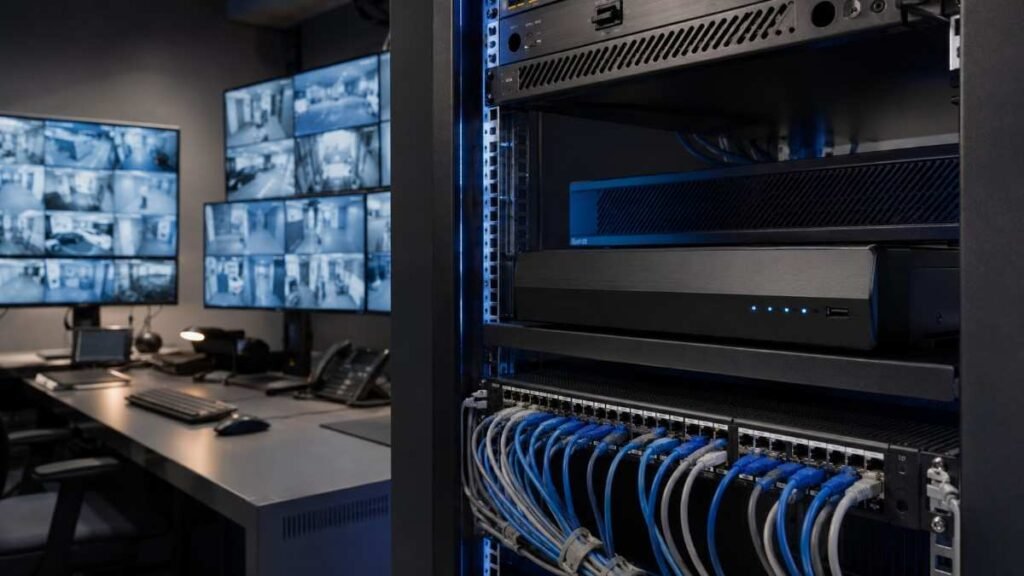
A recurring issue in surveillance installations is underestimating storage requirements. Installers sometimes choose minimum viable configurations that provide enough storage to satisfy the client brief at commissioning, but fail to support 30-day retention at the resolution and frame rate the cameras actually use.
You need to calculate the number of cameras, recording resolution such as 2MP, 4MP, or 8MP, frames per second, compression codec, and whether the system records continuously or only when motion triggers it. H.265 roughly halves storage requirements compared with H.264 at similar quality. H.265 encoding support is worth treating as a non-negotiable specification for any deployment where long-term retention matters, simply because of the storage cost differential over time.
What the Spec Sheet Doesn’t Tell You
Product datasheets are written for global markets even with state of the art technology. They provide channel capacities, memory capacities, resolution capability, and networking capabilities. What they fail to address is the issue of how a particular device deals with a corrupted hard disk at 2 am during a public holiday without anyone from technical support present, how user-friendly its interface is to a property management person who is not an IT expert, or whether there is a local distributor of the brand that could provide spare parts quickly.
When it comes to local markets, service becomes just as important as the initial specifications. A system that takes six weeks to source replacement drives from an overseas warehouse is not a functional surveillance system during that gap — it is a liability.
The decision-making process for surveillance infrastructure benefits enormously from slowing down the specification phase. Asking harder questions about the operating environment, the maintenance model, such as to maintain aging buildings effectively, the compliance obligations, and the long-term storage economics produces installations that continue to function reliably — in heat, in rain, in remote locations, and through the occasional earthquake.